Reading the 18+ Compliance Pages on an Adult AI Platform
Compliance pages are the least read and most informative part of an adult platform, and on this one there are three of them. The 2257 statement says the content is AI-generated text that depicts no real person and that the site does not produce images or video; the content removal policy and the complaints policy cover what happens when something needs raising. Reading all three takes about twelve minutes, once.

Key takeaways
- The 2257 page states what the content is: AI-generated text, no real person depicted, no images or video produced by the site. That sentence resolves most realism questions.
- The content removal policy gives two routes - a report from the content item itself, and an address for reports that do not fit that route.
- The complaints policy covers process rather than content; read it the first time you need it and never in a hurry.
- Twelve minutes once is the cost. Set against a habit of 540 messages a month, that is under 5% of the time a light month takes to type.
What the 2257 statement is doing on the page
The 2257 compliance statement exists because adult platforms are expected to say something about the people and material involved. This one answers with a specific and narrow claim: the content is AI-generated text, no real person is depicted, and the site does not produce images or video. Read it as a technical description rather than a legal formality, because it is the sentence that settles what you are looking at.
Two consequences follow. First, questions of the kind asked about photographed or filmed material do not apply here, because nothing in that category is generated by the platform. Second, the parts of the experience that carry privacy weight are your account, your device and your notes, which is why the device habits matter more on a text platform than any feature comparison. The page carries a last-updated date of 8 February 2025, which is worth noticing: a dated statement is a maintained one, and it tells you when the wording was reviewed.
Compliance language is also the best antidote to marketing language. A product page wants to create an impression; a compliance page wants to describe a boundary. When the two disagree, the compliance page is the one that will still be accurate in a year, and the platform's FAQ, which says some limitations apply under its content and community guidelines, belongs to the second category rather than the first.
The two policy pages that handle objections
The content removal policy is the practical one. It sets out how a report is made - from the content item itself, when the problem is a specific character or page - and names an address for reports that do not fit that route. That matters for a reader because reporting is the mechanism behind the boundary: an adult platform that keeps an unfiltered shelf honest is one where a reader who sees something wrong has a documented way to say so.
The complaints policy is the procedural counterpart. It deals with how a complaint is received and handled rather than with what is or is not permitted, and the reason to read it before you need it is simple: the moment you need it, you are annoyed and in a hurry, and the page is written for someone who is neither. Crushon keeps all three documents in the site footer, which is where they belong rather than buried behind a help widget.
Between the three pages you can answer almost every question a new reader has about the rules, including the one that marketing copy tends to blur: an unfiltered platform with published guidelines is not a platform without rules. Filters such as Filtered, Unfiltered and 18+ exist alongside those guidelines rather than instead of them, and the 18+ filter is the platform's way of stating who the product is for.
| Page | What it states | The question it answers |
|---|---|---|
| 2257 compliance statement | Content is AI-generated text; no real person is depicted; no images or video are produced by the site | What exactly am I looking at? |
| Content removal policy | How to report a specific content item, and an address for other reports | How do I flag something that is wrong? |
| Complaints policy | How a complaint is filed and handled | What process applies if I raise an issue? |
| FAQ restriction answer | Some limitations apply under the content and community guidelines | Does unfiltered mean unmoderated? |
| Site footer and page dates | Copyright year 2025 and a February 2025 revision date on the 2257 statement | Is the policy set current? |
Worked example: pricing twelve minutes against a month of use
Start with the reading itself. Three pages at about four minutes each is twelve minutes, and it is a one-time cost unless a policy is revised. Now put that next to ordinary use: 18 messages a day is 540 messages in a 30-day month, which at 30 seconds of typing each is 270 minutes, or 4.5 hours. Twelve minutes is roughly 4.4% of that, and it is spent once rather than monthly.
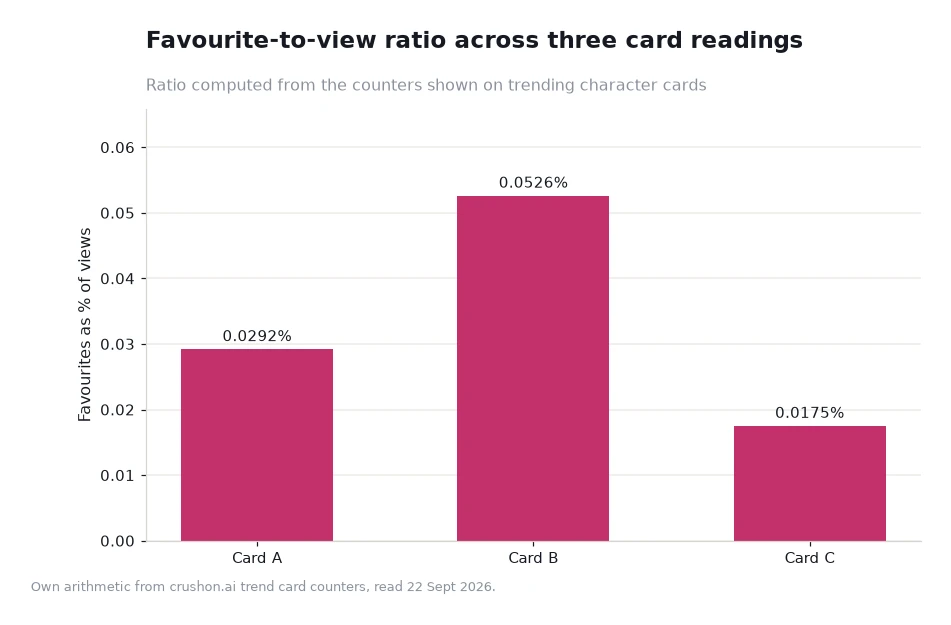
Then use the counters for the second half of the comparison. Keep rates on three card readings came out at 0.0292%, 0.0526% and 0.0175%, a threefold spread between the lowest and the highest; one reading reproduced a published counter exactly, at 0.0292% for 7.1K favourites against 24.3M views. Those figures describe how much attention the shelf commands. The compliance pages describe what the shelf is, and no counter can tell you that.
Both halves of that arithmetic are illustrative except the published counters, which were read on 22 Sept 2026. The point is deliberately unglamorous: the cheapest information about an adult platform is the part nobody reads, and it costs less than one per cent of the time the habit takes in a year.
Reading the rest of the platform in the same spirit
Once the compliance pages make sense, the rest of the site stops being ambiguous. The navigation separates Characters, Memories and Creators, and the search page runs Creators and Characters leaderboards alongside the weekly rankings; those labels tell you what the platform thinks its product is made of. Where creators are credited on a card as "by ...", the credit is the accountability mechanism that goes with the tagging system.
Open the site at https://crushon.ai/ and read in this order: the 2257 statement, the content removal policy, the complaints policy, then the FAQ. Twenty minutes for the whole set, and afterwards every marketing sentence has a context. That is a better use of a first evening than browsing a shelf, because it decides what kind of product you are dealing with before any of your own content exists.
Two practical notes to finish. Keep the report address somewhere you can find it without searching, since the moment you need it is the moment you least want to hunt. And re-read the 2257 page whenever you notice its date change, because on a platform built on generated text the statement is the one document that describes the material itself rather than the service around it.
Frequently asked questions
How many compliance pages does the platform publish?
Three that matter to a reader: the 2257 compliance statement, the content removal policy and the complaints policy. Between them they cover what the content is and how to raise an issue.
Does the 2257 page mention real people?
It states the opposite: the content is AI-generated text, no real person is depicted, and the site does not produce images or video. The page carries a February 2025 revision date.
Is it worth reading all three before signing up?
Yes, and it costs about twelve minutes. Measured against a 540-message month at 30 seconds a message, that is under 5% of the time the habit takes.
Read the boring pages first
Spend the first twenty minutes on the statements rather than the shelf: the 2257 page, the removal policy, the complaints policy and the FAQ, in that order. Save the report address where you can reach it, note the revision date on the 2257 page, and treat the guidelines as the frame that any volume or feature question sits inside. After that, everything else on an adult AI platform - filters, tags, counters, even the leaderboards - is a detail you can judge on your own terms because you already know what the product says it is.
Data: the 2257 compliance statement (last updated 8 February 2025), the content removal policy, the complaints policy and trending card counters, read 22 Sept 2026[1]. Time figures are own arithmetic presented as an illustrative profile. This article is intended for adults 18 and over.